We deliver PAN India in 4-5 days and 1-2 days with Gujarat and Maharashtra.
We deliver PAN India in 4-5 days and 1-2 days with Gujarat and Maharashtra.


How Many Packaging Vendors Do You Really Need?
The honest maths of vendor consolidation — hidden costs, the four tests of a real one-stop supplier, and when one vendor is wrong.
6 min read · Updated July 2026

Most kitchens we talk to buy containers from one supplier, meal trays from another, cups and lids from a third, and bags or cutlery from whoever answered WhatsApp fastest that week.
Nobody planned it that way. It accumulates — a new dish needed a tray the container vendor didn't stock, a cheaper cup turned up at the local market, a friend recommended someone for bags. Eighteen months later, procurement is four relationships, four price lists and four follow-up calls, and it feels normal because it grew one reasonable decision at a time.
This post is the honest maths of that arrangement: what vendor sprawl actually costs, when consolidating to one supplier genuinely pays, and — because we'd rather be straight with you — when it doesn't.

Four vendors versus one supplier: the shape of the problem
The costs that never appear on an invoice
Unit price is the only number that gets compared, because it's the only number that's written down. The costs of sprawl are real but invisible:

Seven hidden costs of running multiple packaging vendors
Three of these deserve a closer look, because they're the ones kitchens consistently underestimate.
Split minimums
Every vendor has a minimum order. Four vendors means hitting four separate minimums, which means overbuying in four places — cash converted into stock sitting on shelves, multiplied by four. Consolidated, one minimum covers the whole basket, and your storage stops absorbing the difference.
The mismatched lid
This is the sprawl failure that reaches your customer. The container came from vendor A. The lid that "fits" came from vendor B. It seats fine when packed flat — and lets go at 30 degrees in a delivery bag. Nobody catches it in the kitchen, because in the kitchen the tray is never tilted.
Containers and lids from one supplier are specified together. That single sentence quietly removes an entire complaint category. (For why lid seating decides your complaint rate, see the thali tray guide.)

One thali order: tray, container, sauce cup, side tray from one supplier
Diluted leverage
Your monthly packaging spend split across four vendors makes you a small customer four times. The same spend at one supplier makes you a number worth negotiating with — better pricing, better credit terms, priority when stock is tight. Sprawl doesn't just cost time; it costs bargaining power you already earned.
What "one-stop" has to actually mean
A supplier isn't a one-stop solution because their catalogue is long. The claim has to survive four tests:
Range that covers your list, not theirs. The test is simple: put your last three months of packaging purchases in one column and check them off against the supplier's range. 80%+ coverage is consolidation territory. 50% is a second vendor wearing a one-stop costume.
Components that match. Lids that seal the containers, cutlery packs that fit the bags, sauce cups that sit inside the meal boxes. A range is only a range if the pieces work together.

Range across categories: containers, trays, cups, plates and combo trays
Minimums you can actually hit. A one-stop supplier with a minimum built for hotel chains isn't one-stop for a two-outlet cloud kitchen. Per-SKU minimums matter more than the headline MOQ.
Consistent quality across categories. One supplier means one quality standard — which is only an advantage if that standard is good. Sample across categories before consolidating, not just the SKU you order most.
The honest part: when one vendor is wrong
Consolidation has failure modes, and a supplier who won't tell you them is selling, not advising.

When to consolidate and when to keep a second source
Single point of failure. If one SKU is business-critical at high volume — the container your entire menu ships in — a backup source for that specific item is cheap insurance. Consolidate the basket; dual-source the one thing that would stop your kitchen.
Price drift. A consolidated supplier who knows you won't leave can let pricing creep. The fix isn't four vendors; it's a price check on your top five SKUs once or twice a year. Keep the leverage of being able to move without paying the cost of actually splitting.
Specialty items. If one product is genuinely specialist — a custom-printed rigid box, an unusual format — a specialist may beat a generalist on that item. Fine. Consolidate the other 90%.
The goal was never one vendor for its own sake. It's the fewest vendors that still keep you safe.
How to consolidate without disruption
Don't switch everything in one week. The sequence that works:
List your last 90 days of packaging purchases — every SKU, every vendor, monthly volume.
Map it against the candidate supplier's range. You're looking for that 80% coverage.
Sample across categories, not just your biggest SKU. Quality consistency is the whole point.
Move one category at a time, starting with the least critical. Bags before containers.
Run the old and new vendor in parallel for one cycle on anything critical.
Renegotiate once volume is consolidated. This is the step people forget — the pricing conversation is the reward for steps one through five, and it doesn't happen automatically.
Where Pack-Tamam fits
This is the part where we tell you what we are, having told you what to check.
190+ SKUs across the categories a kitchen buys: containers, meal trays, bowls, cups, plates, cutlery, tissues, bags, aluminium and more
Matched components — lids specified with their containers, not approximately compatible
Low minimums per SKU, so consolidating doesn't mean overbuying
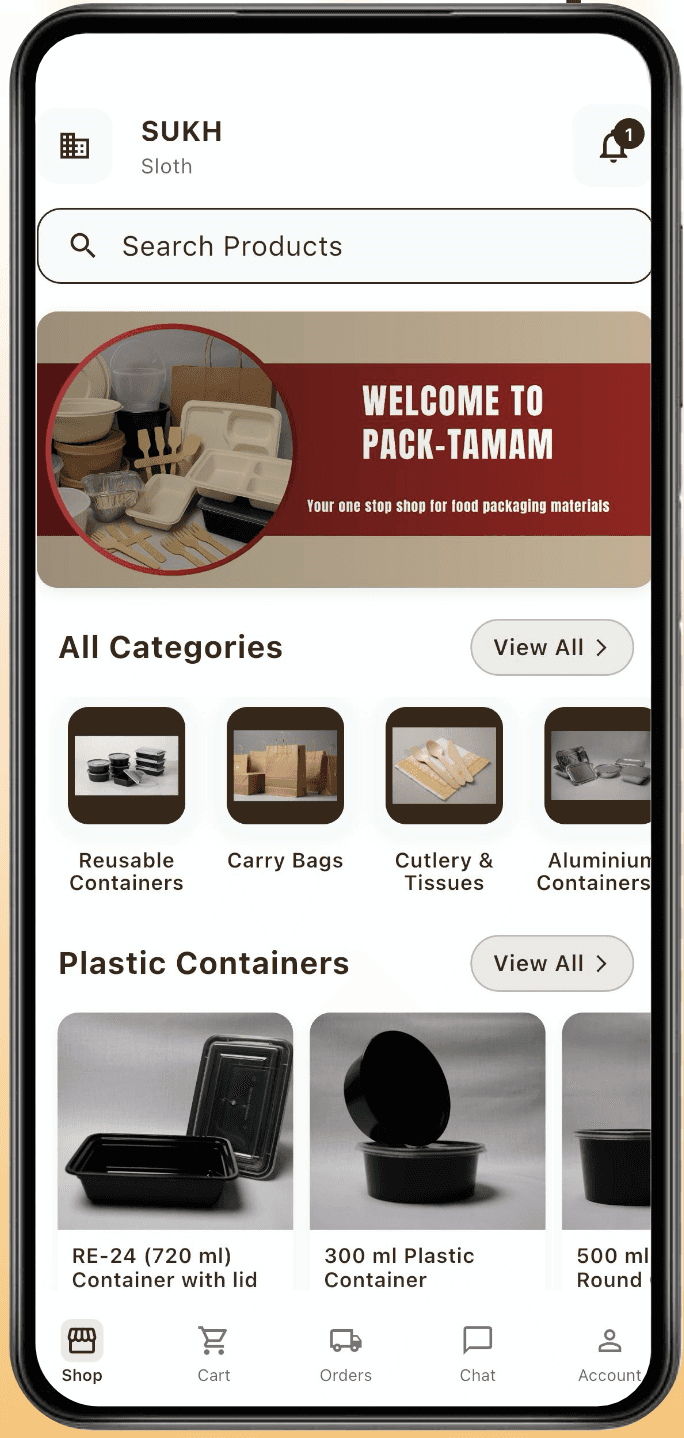
One order on the app, one delivery, one invoice — the entire point, operationalised
Bulk pricing quoted in minutes once your volume is in one place
Run us against the four tests above. Put your 90-day purchase list next to our range and see what the coverage number says — that's the honest way to decide, and it's the comparison we'd want if we were buying.
Browse the full range on the app — or send us your purchase list for a consolidated quote.
Also worth reading: Which container should I use? · Thali and combo packaging
EAT GOOD | FEEL GOOD
FRAMER CMS FIELDS
Slug: one-stop-packaging-supplier
Meta title (SEO): One-Stop Packaging Supplier: The Maths of Vendor Consolidation | Pack-Tamam
Excerpt / card description: The cheapest container and the cheapest supplier are rarely the same thing. Here's what running four packaging vendors actually costs — and when one is enough.
EAT GOOD | FEEL GOOD








Stay in the loop with PACK-TAMAM
Sign up for emails to know the latest on Pack-Tamam offerings, hand-picked packaging updates, and more.
By signing up, I agree to Pack-Tamam’s terms and conditions and to receive updates and emails.


© 2026 PACK-TAMAM Inc. All rights reserved.
