We deliver PAN India in 4-5 days and 1-2 days with Gujarat and Maharashtra.
We deliver PAN India in 4-5 days and 1-2 days with Gujarat and Maharashtra.


India's Food Packaging Market in Four Charts

PACK-TAMAM / INDUSTRY NOTES
India's Food Packaging Market in Four Charts
Market size estimates that disagree threefold, where the material mix is shifting, and the regulatory ramp to 2029.
4 min read · Updated Oct 2026
Every packaging article opens with a market size. Almost none of them mentions that the number is contested.
We looked at what the major research houses say about India's food packaging market. The estimates vary by roughly three times — for the same country, in the same period.
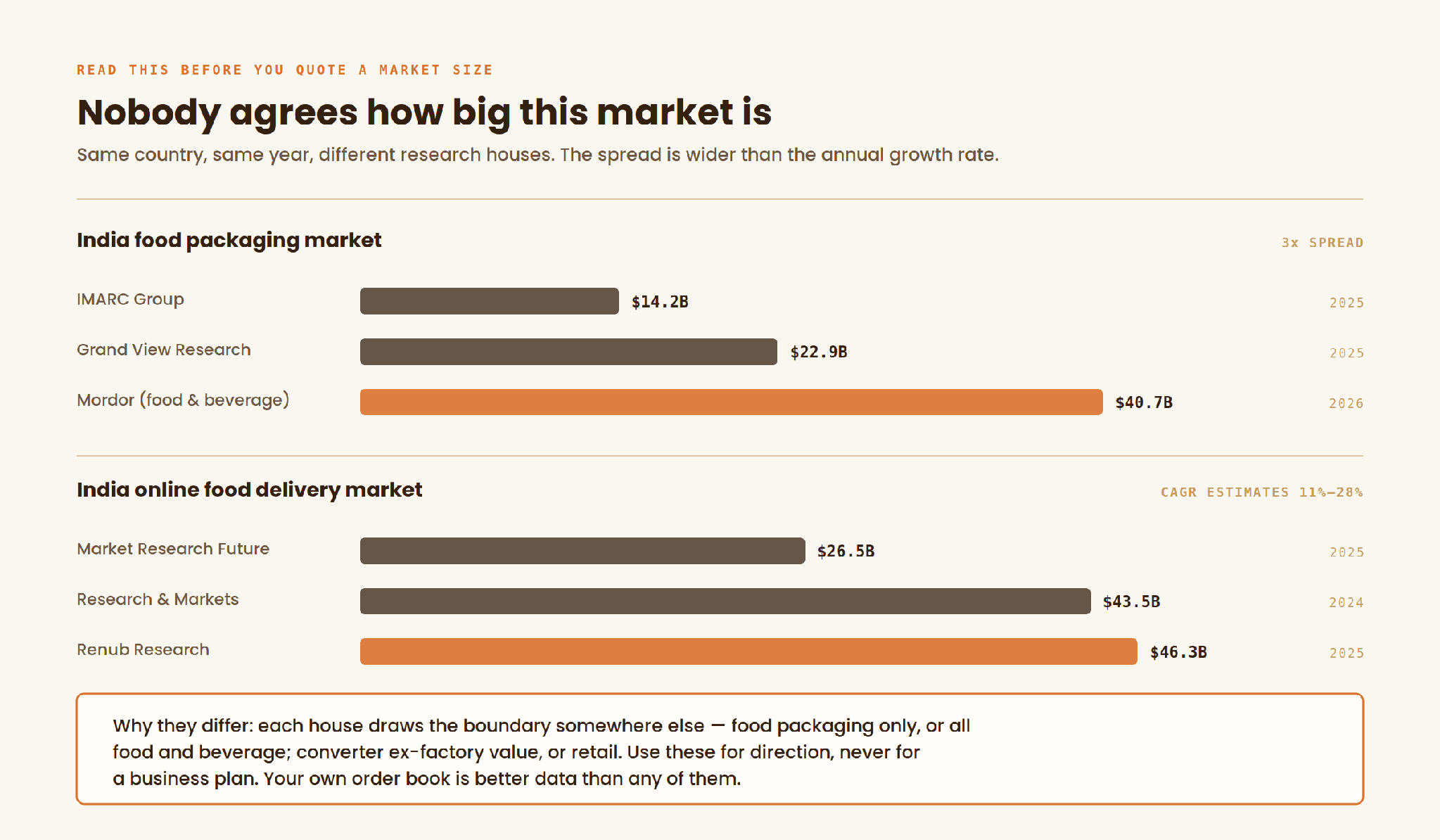
Chart comparing India food packaging and food delivery market size estimates from multiple research firms
The reason isn't that someone is wrong. It's that each house draws the boundary somewhere else: food packaging alone or all food and beverage packaging, converter ex-factory value or retail value, rigid formats only or everything flexible too. The delivery market shows the same pattern — projected growth rates from roughly 11% to 28% a year, depending on the model.
What to do with that: use these numbers for direction, never for a plan. If you run a kitchen, your own order book is better data about your packaging demand than any market report. The macro picture is useful for one thing only — telling you which way the ground is moving under you.
Here's what it does tell us.
The material mix is shifting, but slowly
Plastic still holds the majority of India's food and beverage packaging. That surprises people who assume the sustainability transition is further along than it is.

Chart of India food packaging material share in 2025 versus projected growth rates
The interesting column isn't share — it's growth. Kraft and barrier-coated papers are growing faster than the overall market. Compostable polymers are growing several times faster than that, but from a base of under 4% of the food bags market, which is exactly why they feel more prominent in conversation than they are in tonnage.
Read it this way: plastic isn't disappearing this decade, but the alternatives are getting cheaper, better and more available every year, because volume is what drives both. The practical consequence for a buyer is more format choice in compostables than you had two years ago — and that's the reason to re-test alternatives you rejected on performance in the past.
The regulation is the real story
If you only track one thing on this list, track this one. Market sizes are estimates. Compliance obligations are dated.

Timeline of India packaging regulation from 2016 Plastic Waste Management Rules to 2029 targets
Ten years of amendments, and not one of them has reversed direction — only adjusted deadlines. The 2022 single-use plastic ban removed specific items. The 2025 marking requirement added on-pack traceability. And in April 2026, Extended Producer Responsibility moved from a framework to something you register for, file returns on, and can be audited against.
Two details matter to a food business specifically. Certified compostable material under IS 17088 sits outside the recycled-content target, which makes compliance arithmetic simpler rather than harder. And where FSSAI restricts recycled plastic in food-contact applications, shortfalls can be carried forward — recognition that food packaging can't always use recycled content safely.
We've covered what this means for material choice in bagasse vs plastic vs paper.
What a kitchen should actually take from this

Four takeaways for kitchens: volume growth, paper gaining, compliance shift, compostable simplifies
None of this changes what a good container does. Depth still decides whether gravy stays put. Lid seating still decides your complaint rate.
What it changes is what you should be asking a supplier. Two years ago, "what does it cost?" was a complete question. Now it's worth also asking whether they can document what a material is certified as — because increasingly, someone will ask you.
A closing note on numbers
We publish market figures here because they're useful context, and we've shown you the spread rather than picking the most flattering one. Anyone quoting a single confident number for this market either hasn't checked the alternatives or is selling something.
The estimates above come from IMARC Group, Grand View Research, Mordor Intelligence, Market Research Future, Research & Markets, Renub Research and IndexBox, as published through mid-2026. Regulatory details come from the Plastic Waste Management (Amendment) Rules, 2026 and CPCB's EPR framework. Rules change — verify current obligations for your licence category before acting on any of it.
Browse the range on the app — or ask us what a switch would cost you.
EAT GOOD | FEEL GOOD
FRAMER CMS FIELDS
Slug: india-food-packaging-market-charts
Meta title (SEO): India Food Packaging Market 2026: Size, Material Mix, EPR Rules | Pack-Tamam
Excerpt / card description: How big is India's food packaging market? Depends who you ask — the estimates vary threefold. Here's what the macro picture does and doesn't tell a kitchen.
EAT GOOD | FEEL GOOD


Stay in the loop with PACK-TAMAM
Sign up for emails to know the latest on Pack-Tamam offerings, hand-picked packaging updates, and more.
By signing up, I agree to Pack-Tamam’s terms and conditions and to receive updates and emails.


© 2026 PACK-TAMAM Inc. All rights reserved.
