We deliver PAN India in 4-5 days and 1-2 days with Gujarat and Maharashtra.
We deliver PAN India in 4-5 days and 1-2 days with Gujarat and Maharashtra.


Thali and Combo Packaging

How many compartments do you actually need? Layout, material, sealing and the depth problem nobody tests.
7 min read · Updated July 2026

Four textures. Three temperatures. One box.
Rice that must not go gummy. Dal that must not migrate. A sabzi that needs to stay dry. Curd that needs to stay cold next to something that needs to stay hot. And a sweet that will be the first thing the customer looks at.
Nothing else on an Indian menu asks this much of its packaging. A single container can hold a biryani perfectly well. A thali packed in a single container arrives as one dish.
This guide covers the four decisions that matter: how many compartments, which material, how to seal it, and how deep the wells need to be.
Bagasse and plastic compartment meal trays in 3, 5 and 8 compartment formats
Start with compartment count, not tray size
Most kitchens choose a tray by outer dimensions. That's backwards. The number of items you plate determines the compartment count, and the compartment count determines everything downstream — footprint, cost, packing time, and how much rack space a catering order eats.

What fits in how many compartments
3-compartment: your default
Rice or roti in the large well, dal and one sabzi in the two smaller ones.
This is the workhorse. It covers the majority of lunch combos, tiffin subscriptions and single-meal delivery, and it's the fastest to pack because there are only three things to fill. If you run one tray SKU, run this one.

Bagasse three-compartment meal tray, plan view

Black plastic three-compartment meal tray, plan view
Watch for: the large well doing double duty. If you serve both rice and two rotis, check that the roti actually lies flat without folding over the divider.
4-compartment: room for the extra
Same core, plus a fourth well for a sweet, a salad or a papad.
The fourth compartment is usually what lets you charge more for a "special" thali without changing the kitchen process. It's a small packaging upgrade that supports a real price step.

Bagasse four-compartment round plate with stack
5-compartment: the full thali
Rice, dal, sabzi, curd and sweet — each separated.
This is the corporate catering and festival-order format. It photographs well, it feels complete, and it justifies a premium. It's also bigger, costlier per unit, and slower to pack, so it doesn't belong on your everyday delivery menu unless your price point supports it.

Bagasse five-compartment meal tray with matching lid
8-compartment: banquet and wedding
Two rice preparations, multiple curries, paneer, curd, sweet, pickle.
Used where the meal is served immediately and in volume — weddings, banquets, large functions. The constraint here isn't the food, it's logistics: check the tray footprint against your transport racks before you commit to an order quantity, because eight-compartment trays waste a lot of space if they don't nest with your carriers.

Black plastic eight-compartment meal tray
The depth problem nobody tests
Compartment count gets all the attention. Depth is what actually fails.
A well that's wide but shallow looks generous when you plate it and overflows the moment the tray tilts in a delivery bag. Gravy doesn't need much of an angle to breach a low divider, and once it crosses into the rice compartment the order is effectively ruined even though nothing leaked out of the tray.
The test: plate a real thali, seal it, and hold the tray at 30 degrees for thirty seconds. If gravy crosses a divider, the wells are too shallow for your portion sizes — or your portions are too generous for that tray.
Run this before you order ten thousand units, not after.
The fix, when depth isn't enough: move the wettest item into a separate sauce cup and use the well for something dry. It costs a few paise more per order and removes the failure mode entirely.

Small plastic round sauce containers with clear lids
Bagasse tray or plastic tray?
This decision is different for trays than for bowls. A compartment tray carries more weight, spread across a wider unsupported span, so rigidity matters more than it does for a 300ml bowl.

Bagasse tray compared with plastic tray across eight factors
Bagasse trays hold hot, heavy, oily food without softening, feel substantially more premium on arrival, and are genuinely compostable. They're the better choice for catering, premium thalis and anywhere your brand is making a sustainability claim.
Plastic trays seal more tightly, handle customer reheating better, and cost less per unit. For tiffin subscriptions where the customer microwaves the meal, plastic is the honest answer.
If you serve both a daily combo and a premium catering thali, running one material for each is normal. For the full material trade-off across cost, compliance and compostability, see Bagasse vs plastic vs paper.
Sealing: the part that decides your complaint rate
A compartment tray has a large flat opening, which means a large surface to seal. Three options:
Snap-on rigid lid. Fastest to apply, reusable feel, good rigidity for stacking. Check the lid engages on all four corners — a lid that seats on three is the single most common cause of tray leakage.
Film seal. A machine-applied film across the whole tray. The best seal available and genuinely tamper-evident, but it needs a sealing machine and matched tray tooling, so it's a volume decision.
Lid plus tamper sticker. The practical middle ground for most kitchens: a rigid lid with a branded tamper-evident sticker across the seam. Cheap, no machinery, and it visibly signals that the order wasn't opened.

Bagasse three-compartment tray with matching lid
For aggregator orders, some form of tamper evidence is increasingly expected rather than optional. The sticker route gets you there without capital expenditure.
Match the tray to the job

Which tray for which job — delivery, tiffin, catering, banquet
The same thali has different packaging requirements at 3 km and at a 400-plate banquet. Delivery optimises for speed and seal. Tiffin optimises for reheating. Catering optimises for holding time and stacking. Banquet optimises for footprint and presentation.
Stacking and storage, before you order
Two things worth checking with a sample before a bulk order:
How many nest per carton, and does that carton fit your shelf? Trays are bulky relative to their value. A format that nests poorly will quietly consume storage you don't have, and storage cost is real cost even when it doesn't appear on an invoice.
Do filled trays stack without crushing? Empty trays nesting neatly tells you nothing about whether a loaded tray survives another loaded tray on top of it during a catering run.

Bagasse compartment plates stacked in bulk
Costing it honestly
Don't compare tray prices. Compare cost per delivered meal, which is the tray plus the lid plus any sauce cups plus the carry bag — and then the cost of the failures.
A tray that's cheaper by a few paise but leaks once in forty orders will cost you more than the saving, because a leaked thali usually means a refund, a rating, and a customer who tries someone else next week.
Work out your all-in packaging cost per meal, then judge tray options against that number rather than against each other.
Five mistakes we see most
Buying by compartment count alone. Depth and divider height decide whether the separation actually holds.
Stocking four tray formats. Two is almost always enough; more fragments your volume and weakens your pricing.
Never testing a loaded tray in transit. Plate it, seal it, tilt it, ride with it.
Ignoring the lid. A good tray with a poorly seating lid is a bad tray.
Sizing the tray to the menu you plan to launch, rather than the one you actually sell today.
How Pack-Tamam helps
Compartment trays in bagasse and plastic, from 3 to 8 wells
Matched lids — because a mismatched lid is where trays fail
Sauce cups and tamper-evident stickers to complete the pack
190+ SKUs, bulk pricing quoted in minutes
Low minimum order quantities, so you can trial a format before standardising on it
Get the tray right and the thali travels
A thali is a lot of separate decisions arriving as one plate. The tray is what holds those decisions together between your kitchen and the customer's table.
Choose the compartment count from your menu, the material from your price point, and the seal from your complaint rate. Then test it loaded, not empty.
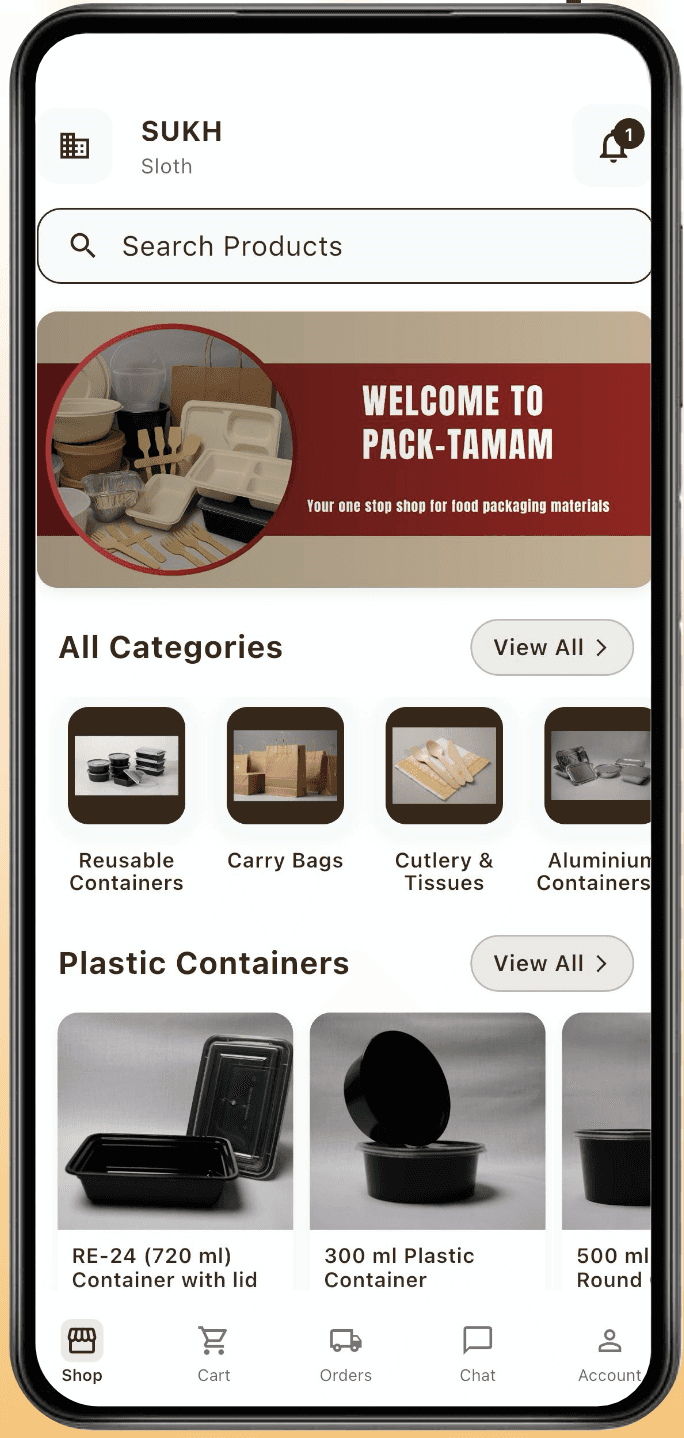
Browse meal trays on the Pack-Tamam app — or request samples and bulk pricing.
Not sure which format fits your menu? Send us your thali plan and we'll spec it. Also worth reading: Which container should I use?
EAT GOOD | FEEL GOOD
FRAMER CMS FIELDS
Slug: thali-combo-tray-guide
Meta title (SEO): Thali & Combo Tray Guide: Compartments, Material, Sealing | Pack-Tamam
Excerpt / card description: A thali is the hardest thing to deliver: four textures, three temperatures, one box. Here's how to pick the tray that holds it together.
EAT GOOD | FEEL GOOD








Stay in the loop with PACK-TAMAM
Sign up for emails to know the latest on Pack-Tamam offerings, hand-picked packaging updates, and more.
By signing up, I agree to Pack-Tamam’s terms and conditions and to receive updates and emails.


© 2026 PACK-TAMAM Inc. All rights reserved.
