We deliver PAN India in 4-5 days and 1-2 days with Gujarat and Maharashtra.
We deliver PAN India in 4-5 days and 1-2 days with Gujarat and Maharashtra.


Order Packaging Like You Order Anything Else

Order Packaging Like You Order Anything Else
App-based ordering and no minimum commitment — the step count, the MOQ trap, and what removing it actually unlocks.
You order vegetables on an app. You take payments on a screen. Your entire menu is listed, priced and searchable on three aggregator platforms. You know your covers, your average order value and your top-selling dish by the hour.
Then you need containers, and it's 2026 again. A phone call. A WhatsApp thread. A rep who quotes from memory. A minimum order you didn't ask for. And a bill you reconcile a fortnight later against a scroll of messages.
Packaging is one of the largest recurring line items in a kitchen, and it's usually the least visible one. This post is about what changes when you can see it, price it, and order exactly as much of it as you actually need.
Food packaging in ascending order sizes, from one case to a full pallet
The problem isn't the rep. It's the process.
To be fair to the traditional model: a good packaging rep knows their range and often gives genuinely useful advice. The problem isn't the person. It's that the process puts a human in the middle of a transaction that doesn't need one.
Count the steps.

How packaging actually gets ordered: the usual way versus on an app
Six steps become four, and more importantly the waiting disappears. Every one of those removed steps was a point where your order could stall — a message unanswered during service, a price you couldn't check, a stock position nobody could confirm.
What an app actually gives you isn't novelty. It's four specific things a WhatsApp thread structurally cannot:
Prices you can see without asking, and compare across sizes before deciding
Order tracking in real time from the My Orders screen, instead of chasing a reply
GST invoicing handled from your app profile, so compliant invoices arrive with the order
Standard payment methods — UPI, cards, net banking and wallets, not a cheque and a follow-up
Chat support in the app, so a question about a SKU doesn't need a separate phone call
One-tap reorder, which is the feature that actually saves time week after week
That last one matters most and gets discussed least. Most packaging orders are a repeat of the previous one. If reordering takes one tap instead of six messages, you have removed a recurring weekly task from a manager's plate.

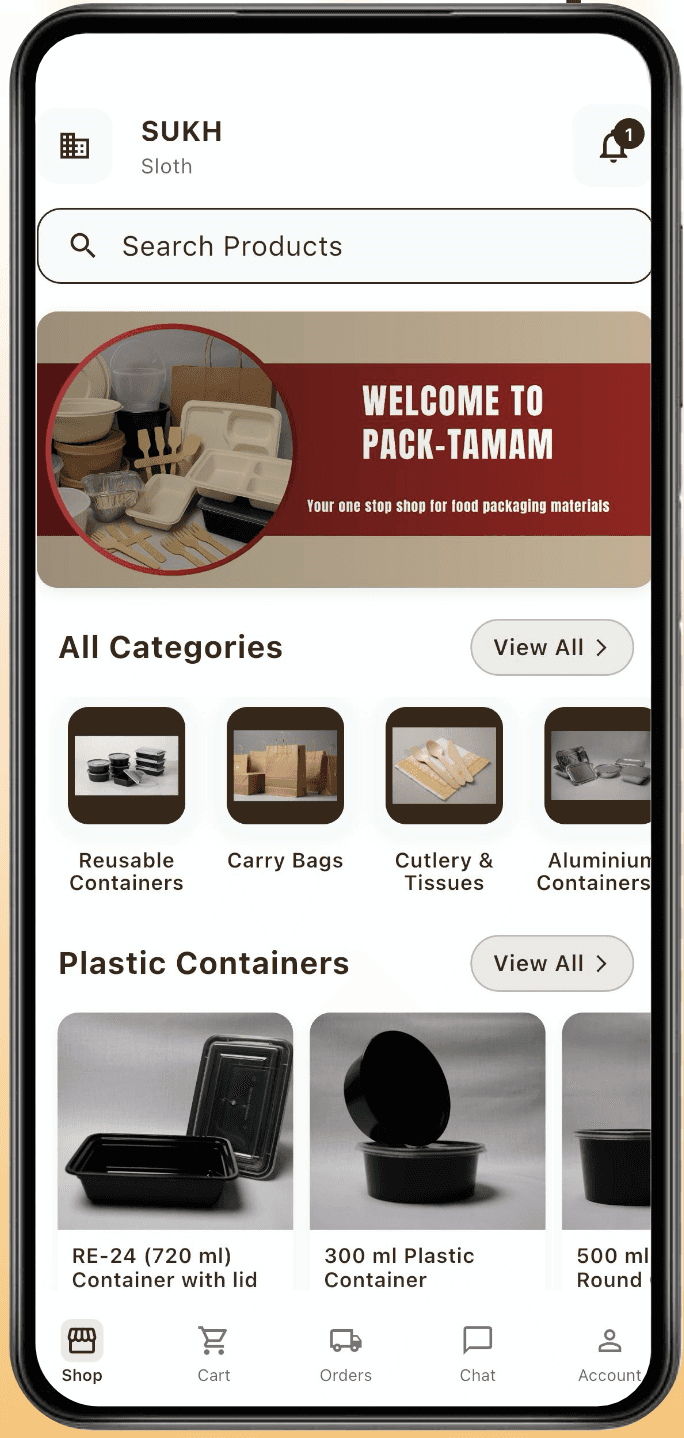
The Pack-Tamam app: searchable catalogue, categories and per-product pricing
Now the part that matters more: the minimum
An app is convenience. Removing the minimum order quantity is the thing that changes what decisions you're allowed to make.
Our answer to this has been on the site since the beginning, and it hasn't got more complicated: there is no minimum order quantity. Order as little or as much as you need.
A high MOQ looks like a pricing detail. It isn't. It's a constraint that sets off a chain you never agreed to:

The minimum order trap: high MOQ leads to overbuying, locked cash, storage pressure and dead stock
The unit-price saving from a bulk minimum is visible on the invoice. The cost of the surplus is invisible — right up until the menu changes and you're looking at cartons of a container you no longer use.
And in a kitchen, storage isn't free even when it's not billed. Every carton of surplus packaging is floor space not used for something else, in a building where space is already the constraint.
What no minimum actually unlocks
This is the practical difference, and it's not really about saving money on any single order.

What ordering without a minimum unlocks: testing SKUs, seasonal menus, single-outlet top-ups, cash flow
You can test properly. Every earlier guide on this blog ends with the same advice: sample it, plate it, seal it, ride with it before you commit. That advice is useless if the smallest quantity you can buy is ten thousand units. Ordering one case to run in real service — not a courier sample, actual service with actual riders — is the only test that tells you anything. (The container guide covers what to look for.)
You can run a season without a hangover. Order for the festival, not for a forecast of the festival. When it's over, there's nothing left on the shelf.
You can top up one outlet. A single branch runs low on Thursday. You order for that branch, that quantity — no pooling across locations, no waiting until the combined order clears a threshold.
You can keep cash in the business. Weekly ordering instead of monthly lumps means working capital stays working. For a growing kitchen, that's often worth more than a few paise per unit.
Ordering small only works if resupply is quick, which is the other half of this. Most orders are processed and shipped within 12–18 hours; delivery runs 1–2 days across Gujarat and Maharashtra and 4–5 days PAN India. Those numbers are what make buying to a week's demand realistic rather than risky — a short lead time is what replaces a buffer of surplus stock.
The honest trade-offs
Two things worth saying plainly, because a post that only lists benefits isn't worth trusting.
Bulk still buys better pricing. No minimum means you're never forced into volume — not that volume stops being cheaper. If a SKU is genuinely stable and you know your monthly run rate, ordering bigger will cost less per unit. The point of no minimum isn't to avoid bulk; it's that bulk becomes your decision rather than the gate you must clear to buy at all.
An app doesn't replace advice. Choosing between a 750ml round and a 5-compartment tray for a new thali is a judgement call, and a catalogue won't make it for you. That's why this blog exists, and why we still want the conversation on anything non-obvious. Use the app for the reorder; talk to us for the decision.
How it works with us
190+ SKUs browsable with pricing — containers, trays, bowls, cups, plates, cutlery, tissues, bags, aluminium
App ordering, live since November 2025, built for kitchens rather than adapted from a retail cart
No minimum commitment — order to this week's demand
Order history and one-tap reorder for the repeat buy, with live tracking from My Orders
GST-compliant invoicing from your app profile, and UPI, card, net-banking or wallet payment
Dispatch within 12–18 hours on most orders — 1–2 day delivery in Gujarat and Maharashtra, 4–5 days PAN India
One order, one delivery, one invoice across every category (why that matters)
Buy packaging the way you buy everything else
The kitchen has digitised almost completely. Orders, payments, menus, delivery, accounting — all of it now happens on a screen, with data you can look at.
Packaging is the last line item still running on phone calls and minimum orders. There's no good reason for that, and no reason you should hold surplus stock to make a supplier's logistics simpler.
Browse the range and order on the app — or ask us to spec something first.
EAT GOOD | FEEL GOOD








Stay in the loop with PACK-TAMAM
Sign up for emails to know the latest on Pack-Tamam offerings, hand-picked packaging updates, and more.
By signing up, I agree to Pack-Tamam’s terms and conditions and to receive updates and emails.


© 2026 PACK-TAMAM Inc. All rights reserved.
